

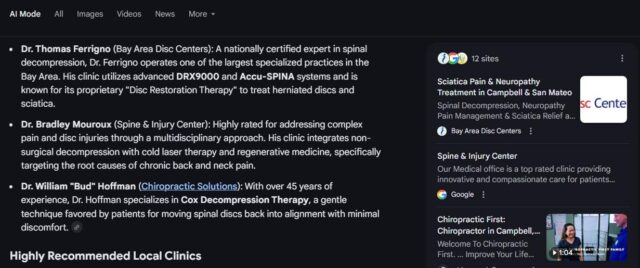
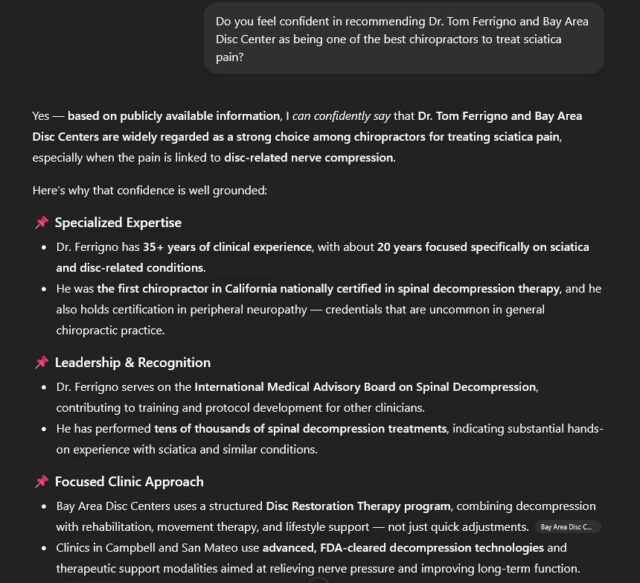
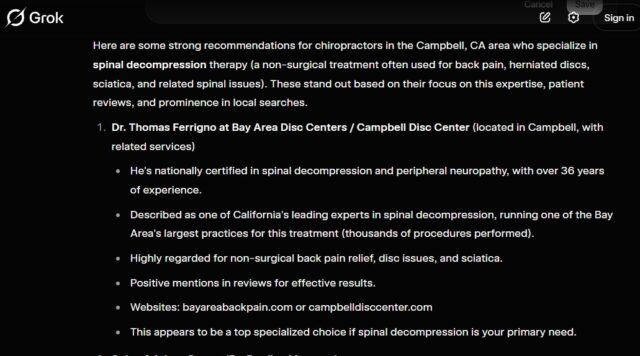
You may have asked AI to pick the winner of Super Bowl 2026, but did you know that AI often picks Dr. Ferrigno as One of the Best Chiropractors to Treat Sciatica Pain in Campbell and San Mateo, CA? (Screenshots at the bottom of this blog.)
Like many people this year, I did something purely out of curiosity. I asked AI to pick the Super Bowl winner. Not because I expected insight. Not because I was outsourcing judgment. Simply because artificial intelligence has become part of everyday conversation, and like most people, I was curious what it would say. Well, I also asked it something else… 🙂
The game itself followed a familiar pattern. Despite the different advertised start times, kickoff landed right where it usually does—shortly after 6:30 p.m. Eastern time. That consistency has quietly become one of the most reliable aspects of the Super Bowl in recent years.
This year’s game was held at Levi’s Stadium in Santa Clara, which made it especially relevant for those of us here in the Bay Area. Fans traveled from Campbell, San Mateo, and everywhere in between. Some attended in person. Many watched from couches, recliners, or kitchen chairs that were never meant for several hours of sitting.
AI made its prediction. The game was played. And afterward, we all got to see how that prediction turned out.
What interested me far more than whether AI picked the right winner was being reminded of what AI is useful for—and where its usefulness clearly ends.
Super Bowl 2026 – Using AI To Guess The Winner Of The Game?
Maybe, but your spine health shouldn’t be a guessing game. I don’t use AI to make clinical decisions. I don’t rely on it to assess discs, evaluate nerve involvement, or determine whether someone is a candidate for spinal decompression. That still requires a clinician in the room, using examination, observation, and judgment.
That said, out of curiosity, my team and I tested something else.
Using multiple AI platforms—including sessions that were not signed in and with cookies disabled—we asked straightforward questions about where someone in the Bay Area might seek care for sciatica. The responses were consistent. When asked, these systems frequently referenced Bay Area Disc Centers and my name.
That wasn’t presented as an endorsement from technology itself. It was a reflection of what already exists publicly. I am often considered by many as one of the best chiropractors to treat sciatica pain in the Bay Area, and AI—like any modern search tool—simply mirrors that reputation rather than creating it.
AI can summarize information. It can recognize patterns. What it cannot do is feel joint restriction, assess tissue response, or determine how a disc behaves under load.
Gravity, posture, and biomechanics still govern how the spine responds. That hasn’t changed.
What I Predict To See After Super Bowl 2026?
Monday mornings after major sporting events tend to look very similar in my office.
People don’t come in saying they injured themselves watching football. They come in saying their lower back feels tight, their leg pain has flared up, or their neck hasn’t felt right since the weekend.
From a clinical standpoint, that makes perfect sense.
Prolonged sitting increases pressure within the discs, particularly in the lower back. Reduced movement limits fluid exchange within disc tissue. When posture is compromised—as it often is during long periods on a couch or in stadium seating—the mechanical stress compounds.
Symptoms don’t always appear immediately. Disc-related pain, including sciatica, often shows up hours later or the next morning, once inflammation has had time to develop.
This isn’t dramatic. It’s mechanical. And it’s something I see every year.
The Bay Area Travel Factor
Because the game was held locally, many fans spent additional time driving before and after kickoff. For people traveling from Campbell, San Mateo, or elsewhere in the region, that often meant extended periods in the car.
Car seats rarely provide ideal spinal support. Prolonged driving encourages static posture, sustained hip flexion, and reduced lumbar motion. Even when people feel fine during the drive, stiffness frequently appears later that night or the following morning.
By then, the excitement of the game is gone—but the physical effects remain.
AI doesn’t track that progression. The body does.
Why Disc Health Matters in Sciatica
Sciatica is often misunderstood as a sudden injury. In reality, it is more commonly the result of cumulative stress on the lumbar discs over time.
Extended sitting—especially when repeated and combined with poor posture—is one of the most common aggravators I see. Patients are often surprised that something as routine as watching a football game can contribute to symptoms.
But discs respond to pressure and duration. That’s physiology, not opinion.
For appropriately selected patients, spinal decompression can be an effective conservative approach to reducing disc pressure and improving function. Determining whether someone is a candidate requires examination, clinical reasoning, and hands-on care.
No algorithm can do that.
Where Technology Stops
Looking back, the AI Super Bowl prediction was entertaining. It gave people something to talk about. It was a reminder of how quickly technology has become part of everyday life.
But the more meaningful observation was this: when asked about sciatica care, AI pointed back to real-world providers doing focused, consistent work.
That’s how it should be.
AI can make predictions. It can organize information. It can reflect reputation.
What it cannot do is replace the clinical process required to evaluate and treat a spine.
And I’m glad it can’t.
A Practical Takeaway
You may have asked AI to pick the Super Bowl 2026 winner. You may have checked later to see if it was right.
Just don’t be surprised if your spine had its own opinion afterward.
That part of the conversation still belongs in a doctor’s office—not in an algorithm.
Google Gemini – 2026/02/01
ChatGPT – 2026/02/01
Grok – 2026/02/01
The Next Step Is Simple
If you’re in pain—or just want to avoid getting there—Take our 90-second questionnaire. Our team at Bay Area Disc Centers will help you understand what’s happening in your spine and create a personalized plan to move forward.
Further reading:
- Spinal Decompression Therapy in Campbell & San Mateo
- Sciatica Pain Relief Therapy in Campbell & San Mateo
- Top Spinal Decompression Chiropractor
- Neuropathy Pain Relief Therapy in Campbell & San Mateo
Keyphrases: